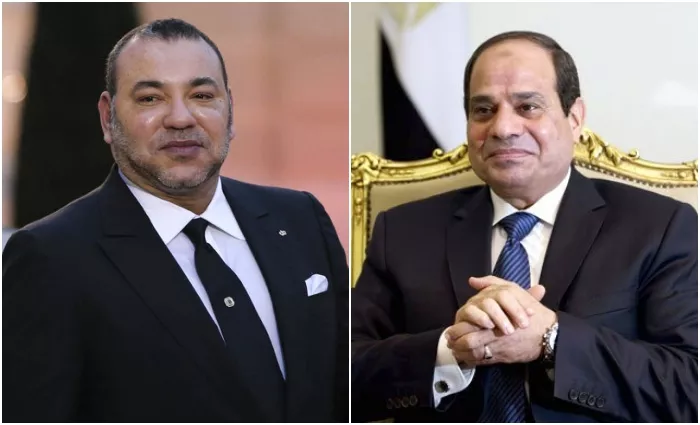
During an official visit to Cairo, Morocco and Egypt signed 16 immediately-actionable agreements and memoranda of understanding covering vital sectors — water desalination, the aircraft and automotive industries, banking, agriculture and logistics — a step that reflects both countries' determination to raise their economic partnership to the level of the historic brotherly ties nurtured under the leadership of His Majesty King Mohammed VI and H.E. President Abdel Fattah El-Sisi.
A Visit That Opens a New Chapter
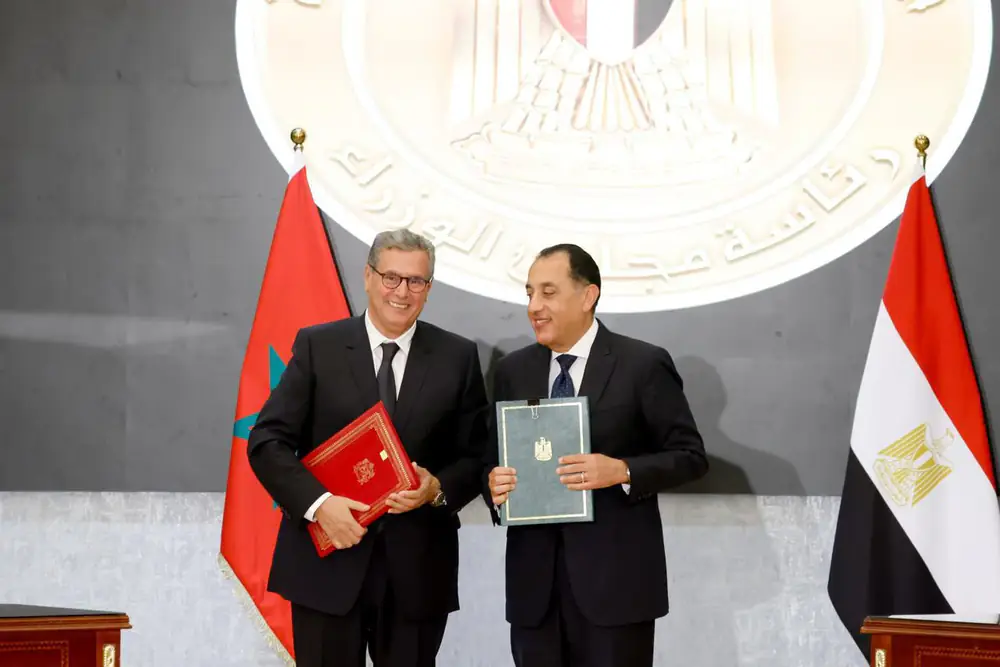
The agreements were concluded during a two-day working visit (7–8 April 2026) led by Head of Government Aziz Akhannouch at the head of a ministerial delegation of seven ministers, aimed at giving fresh impetus to bilateral cooperation.
The visit saw the first session of the Morocco–Egypt Coordination and Follow-up Committee, co-chaired by Aziz Akhannouch and Egyptian Prime Minister Mostafa Madbouly — a mechanism created to overcome the technical obstacles that had hampered the implementation of earlier agreements and to ensure joint projects actually materialise.
The composition of the Moroccan delegation — including ministers Nadia Fettah, Nizar Baraka and Ahmed El Bouari alongside senior industry and trade officials — underlined the strategic character of the visit.
Rebalancing the Trade Balance
At the heart of the talks was the trade imbalance: according to figures presented during the visit, Egyptian exports to Morocco exceeded one billion dollars in 2025 while Moroccan exports remained far below both countries' ambitions, prompting agreement on practical rebalancing measures.
These include removing the non-tariff barriers that hindered Moroccan products — particularly cars, textiles and electronics — from entering the Egyptian market, activating the Agadir free-trade agreement, and creating a "hotline" between the two trade ministries to resolve obstacles immediately.
At a joint press conference, Akhannouch stressed that the goal goes beyond improving figures: the real stake is building "shared economic sovereignty" in strategic fields such as energy, food and water.
For his part, Prime Minister Mostafa Madbouly praised Morocco's development momentum and confirmed Egypt's openness to Moroccan companies participating in major infrastructure projects, notably in the New Administrative Capital and the Suez Canal Economic Zone.
Strategic Sectors and Political Coordination
The agreements extend to strategic sectors: transferring Moroccan expertise in water desalination and wastewater treatment, strengthening agricultural cooperation for food security, and memoranda of understanding in industry — especially aircraft and automotive parts.
They also cover financial and logistical cooperation, linking the two countries' stock exchanges and financial institutions and establishing direct maritime lines between their ports to ease trade and cut costs.
Talks were not limited to the economy: in a meeting attended by Foreign Minister Nasser Bourita and his Egyptian counterpart, the two sides confirmed the alignment of their positions on regional issues — particularly the Libyan file — and stressed support for stability and coordination within the African Union.
The visit also included meetings with Egyptian business leaders on launching Moroccan investments in the Suez Canal Economic Zone, with facilities offered to Egyptian investors, particularly in Morocco's southern provinces and the industrial zones of Tangier and Kénitra.
Exports Winning the Bet
The figures reflect the scale of the transformation underway: Moroccan exports to Egypt jumped from 59 to 323 million dollars in a single year, while Moroccan argan oil has proved a notable success with Egyptian consumers.
According to Morocco's National Food Safety Office (ONSSA) for 2020–2026, Egyptian imports from Morocco rose 151% with a 98% acceptance rate. Dates, oilseeds, pulses and spices dominate the exchanges, involving 437 Egyptian exporters and 140 Moroccan importers across 355 product categories.
Over the same period 17,730 files covering 20,476 consignments — 1.66 million tonnes of imports — were processed in an average of 3.1 days, with 95% completed in under 14 days. Preliminary figures for May 2026 confirm the momentum, driven by customs facilitation and digitalisation.
The Appeal of the Moroccan Market
Cairo sees Morocco as a regional distribution platform, a logistics hub toward Europe and the Mediterranean, and an ideal gateway to West Africa. This is built on solid foundations: political and macroeconomic stability, free-trade agreements with Africa and Europe, advanced port and logistics infrastructure, a strategic location at the crossroads of three continents, and export-oriented industrial policies giving access to some 2.6 billion consumers.
Promising areas of cooperation include technology, artificial intelligence, renewable energy and agri-food — 21% of Morocco's manufacturing industry — while Morocco aims to raise its exports to Egypt to 5 billion dirhams by 2027.
The Private Sector Joins In: CGEM Memorandum with Egyptian Businessmen
In a parallel step to deepen private-sector cooperation, Morocco's General Confederation of Enterprises (CGEM) signed a memorandum of understanding with the Egyptian Businessmen's Association in December 2025 to open new horizons for joint investment.
The signing took place on the sidelines of CGEM's invitation to the association's leadership to attend the opening of the Africa Cup of Nations "Morocco 2025". MP Adel El-Lamei, board member of the association, represented the Egyptian side, while Ali Tazi, president of the Morocco–Egypt Business Council, signed for Morocco.
The memorandum provides for trade missions and joint business meetings to strengthen direct contact between the two business communities and foster an environment conducive to sustainable development.
Industrial Integration, a Win-Win Partnership
The comprehensive strategic partnership between the two countries traces the contours of an economic axis linking North African economies, within the African Continental Free Trade Area and the 2004 Agadir Agreement, with a particular focus on agri-food, automotive and textiles. Morocco brings its export leadership through Tanger Med; Egypt opens the markets of the Middle East and sub-Saharan Africa to Moroccan products.
The joint roadmap includes integrated industries, bilateral trade meetings, economic forums and sector fairs, direct logistics and maritime links between Tanger Med, East Port Said and the Suez Canal corridor, technical exchange on major solar and wind projects, regional cooperation on green hydrogen, and a joint Moroccan-Egyptian investment platform.
Egypt Supports Morocco's Territorial Integrity
Politically, Egypt renewed its support for the territorial integrity of the Kingdom of Morocco — a position reinforced by the latest UN Security Council resolution. Cairo formally reaffirmed this position on 6 April 2026 during the committee's first session, expressing its commitment to the autonomy plan under Moroccan sovereignty as a consensual and lasting solution.
The Moroccan Community Social League in Egypt sees this economic and political momentum as a natural extension of the historic brotherly relations between the two countries, and a promising opportunity for community members and economic actors on both sides.
Sources: industries.ma — Charaf Eddine Sraidi, 07/04/2026 · Atalayar — Khadija Taoul, 13/06/2026.